
FOREWORD
On behalf of the Asian Productivity
Organization, I would like to extend a very
warm welcome to all the distinguished
delegates to the International Productivity
Conference on Knowledge Management here
in the bustling and beautiful city of Bangkok.
We organized this conference to mark two
important events, the 45th anniversary of
the Asian Productivity Organization and the
12th anniversary of the Foundation for
Thailand Productivity Institute. Knowledge
management is not only one of the APO’s
thrust areas but it is growing in importance
in this fast-changing and globalized world.
That is why we decided to choose it as the
central theme of our combined celebration. I very much hope that the coming two days will
prove that our decision was right.
Knowledge management is not merely a fashionable new management trend. It is instead a
logical consequence of developments occurring around us right now. Among them, the most
significant development in terms of elevating the status of knowledge management is, in my
view, the growing importance of innovation as a means to achieve sustained economic
growth in many countries.
In Singapore, a policy shift from productivity-induced growth to innovation-induced growth
took place decades ago. The Republic of Korea has long prided itself on producing human
resources who can lead industry to innovation and breakthroughs. Japan’s new government
came out with a statement that it would make innovation the centerpiece of its economic
policy.
In a way, it is inevitable that high-performing countries will resort to innovation as a means
to stimulate economic growth, as their population growth rates are dwindling and are likely
to drop below zero in the near future. The Japanese fertility rate, or children born per
woman, for example, registered only 1.26 in 2005, while the comparable figure for the
Republic of Korea was 1.08. Even more striking is a sharply declining trend in the fertility
rates of middle-income countries in Asia. The fertility rate in Thailand declined sharply over
the last half-century and in 2005 it stood at 1.7, which was lower than that in the United
States, France or Sweden.
For middle-income countries, the prospect of
achieving economic growth by increasing
labor force participation is very dim indeed. It
is no wonder that interest in innovation as a
means for economic growth has begun to
spread from high-performing countries to
middle-income ones in Asia and the Pacific.
Soon interest will spread to developing countries as well. The days of incremental or continuous improvement preoccupying corporate managers are over. It is to innovation and
breakthroughs that those managers have turned their attention. For achieving innovation,
the most relevant tool is no longer quality control or quality management. It is knowledge
management in its broadest sense, with value creation or knowledge creation being the most
relevant. Many theoreticians and practitioners have realized that creating knowledge by
strengthening the ability to turn the tacit knowledge of staff members into tangible
organizational assets is crucial for organizations.
Today and tomorrow we will have the opportunity to listen to presentations by
representatives from internationally renowned organizations on how they have been utilizing
knowledge management in the pursuit of organizational excellence. Today’s first session
immediately after this ceremonial session will start off with a keynote speech by Professor
Ikujiro Nonaka, who will present his thought-provoking views on knowledge. You will no
doubt learn a great deal from our speakers’ experiences and insights. Our staff members at
the APO Secretariat also look forward to learning and benefiting from them, because the
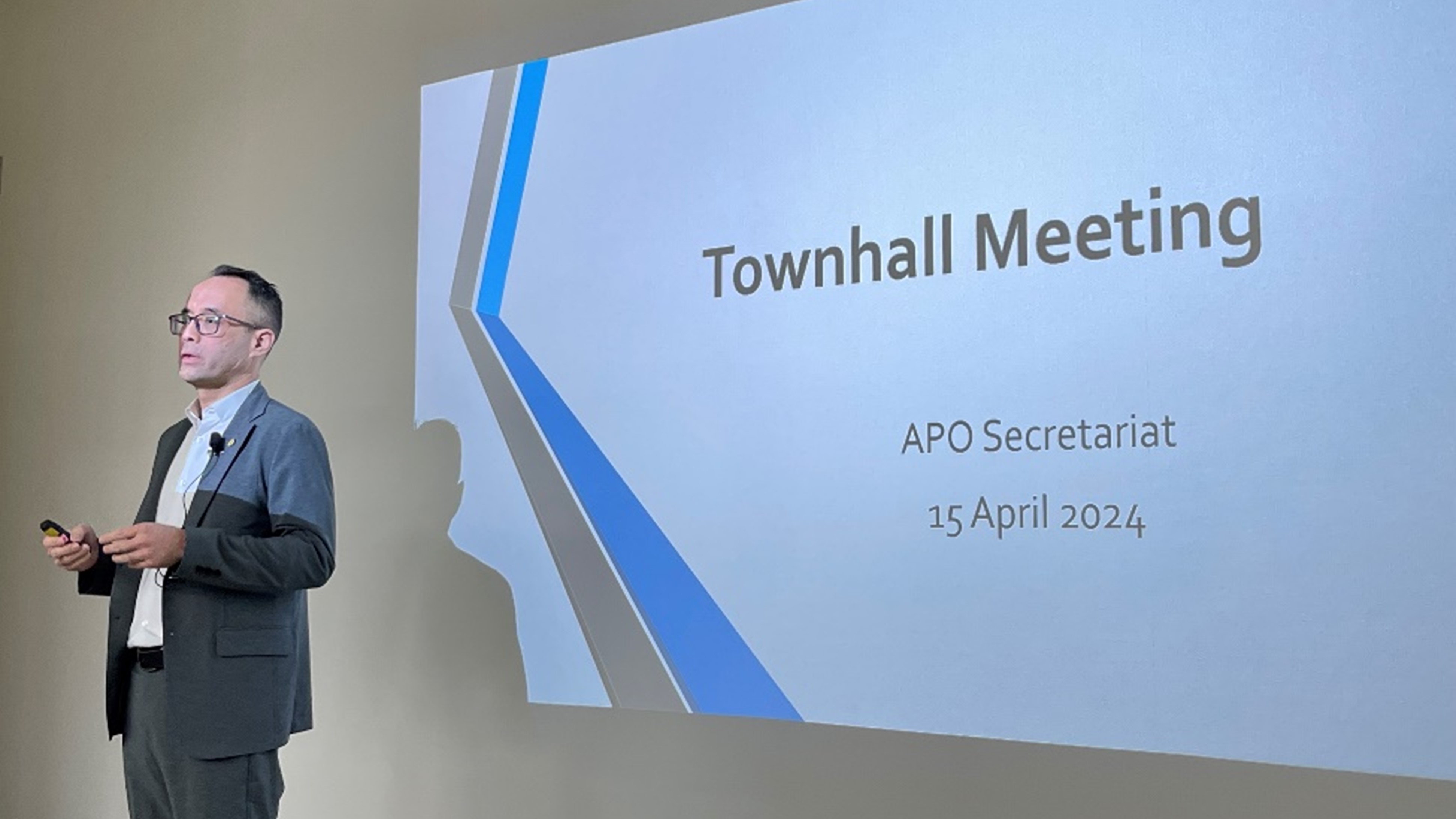
Secretariat itself has embarked on a modest experiment in knowledge creation. This may be
a good occasion to share with you what we have done so far to cultivate a “knowledgephilic”
work culture that allows our staff members to enhance their knowledge-creating
capability.
The Asian Productivity Organization, which was founded 45 years ago, organizes about 100
seminars, training courses and workshops as well as big conferences like this one every year
in various places throughout Asia. We have a compact Secretariat in Tokyo with slightly
fewer than 50 staff members. Although small in number, our officers are capable, active and
diverse in the sense that they came from 10 different countries.
The first measure we took for knowledge management was to create an appropriate work
environment, both physical and virtual. We replaced most of the high partitions and filing
cabinets in the office with low ones to make everything and everybody more visible. We
reduced the number of operational departments from five to three, and reorganized the
layout in such a way that distances among officers are physically closer. In doing so, we
were conscious of the famous “30-meter rule” proposed by Professor Thomas Allen of MIT,
which states that two persons whose desks are more than 30 meters apart have a
communication frequency of almost zero. We then transformed our newly created open
spaces into formal and informal meeting spaces to encourage interaction among staff
members. Finally, we ensured that the new physical layout incorporated IT support.
The second measure we took was to introduce a new reporting system in which the officer
responsible for an APO project is mandated to submit a report on its contents and to make
recommendations to improve it. Previously, we had a reporting system but did not have a
clearly defined format and it was not strictly enforced anyway. Now, however, the
submission of a report after attending an APO project is compulsory. Moreover, guidelines on
items to be reported were announced in which officers are asked to rate project results and
explain the reasons for that rating. Dozens of reports under the new format have already
been submitted and these are full of new ideas and suggestions for operational and
organizational improvement. With the results, I am confident that the APO Secretariat will be
able to provide better service to member countries by offering projects that are more useful,
focused and relevant.
The third measure we took was to demonstrate the commitment of management to the
concept of knowledge management. It is well known that leadership commitment is crucial in
motivating people and creating a new work culture conducive to the creation and sharing of
knowledge. We deliberately encourage brainstorming sessions and IT-supported knowledgesharing
sessions among staff members. The fact that knowledge management was selected
as the theme for IPC 2007 to commemorate the 45th anniversary of the Asian Productivity
Organization is itself the best testimony to our commitment to this concept.
I believe that knowledge management is a key source of innovation in any organization.
Knowledge is going to be the lifeline of an organization just like land, labor and capital were
in the past. So I sincerely hope that all of you benefit from your participation in this
conference. If you can take back even one idea from the conference and implement it in
your own organization to strengthen knowledge-creating capability, I will be more than
happy as the organizer of this event.
Finally, I wish to take this opportunity to thank the Foundation for Thailand Productivity
Institute for its tireless efforts, without which this conference would never have been held.
Thank you.
Shigeo Takenaka,
Secretary-General,
Tokyo
|