
49th Session of the APO Governing Body
26–28 June 2007, Ulaanbaatar, Mongolia
Annual Report of the Secretary-General
by Shigeo Takenaka
Secretary-General, Asian Productivity Organization
Ladies and Gentlemen:
It is my great pleasure to welcome distinguished APO Directors, advisers, and observers to the 49th Session of the APO Governing Body. On behalf of all APO member countries and the Secretariat, I would like to express my sincere appreciation to the Government of Mongolia for hosting this important meeting in the Government House of Ulaanbaatar, located in the spectacular setting of the Mongolian grasslands.
We are very grateful to His Excellency Nambarayan Enkhbayer, President of Mongolia, for his kind, encouraging message. We are honored that His Excellency Dr. Tseren Davaadorj, Minister of Industry and Trade, is gracing this inaugural session. I would also like to thank Dr. Schurchuluu, APO Director for Mongolia and Chairman of the National Productivity and Development Center, for his kind words of welcome and the warm hospitality extended to all of us.
Let me also take this opportunity to extend my heartiest congratulations to the NPDC as it celebrates its 15th anniversary this year. It has contributed much to the development of the Mongolian economy and I am sure that in the years ahead it will continue to evolve to remain at the forefront of the productivity movement in the country.
Almost three years have passed since I assumed the position of Secretary-General of the APO. I must thank you most sincerely for giving me the unwavering support that has enabled me to discharge my duties effectively. I assure you that I will continue to do my utmost to ensure that the APO remains relevant and useful to all our members and stakeholders.
The APO 2006 Annual Report, which has been circulated, gives an account of the activities undertaken last year. Therefore, I will not elaborate further on them. Instead, I would like to provide you with an update on three areas: first, the Reform Plan of the APO with special reference to internal Secretariat reforms; second, the Secretariat’s efforts to balance administrative costs and project costs; and third, continuing efforts to improve APO programs including strengthening and building relations with other regions and organizations. The first and the second areas are closely interrelated and in fact are simply two sides of the same coin.
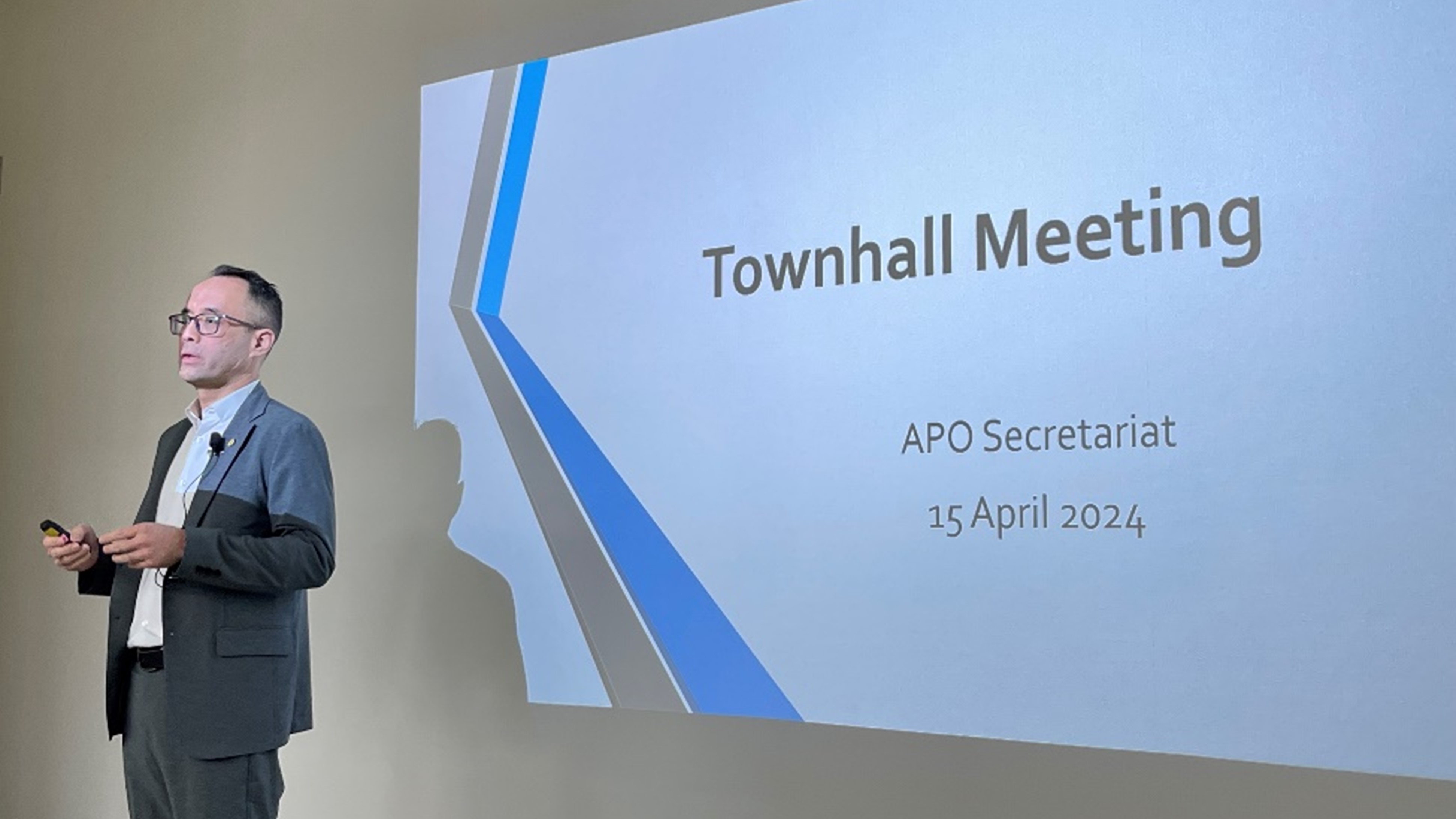
Concerning the Reform Plan, I am pleased to report that the Secretariat has initiated several significant changes to strengthen organizational capacity, the most important of which is the reorganization of the Secretariat from six to four departments. As I described that reorganization in detail at the last Workshop Meeting in Bali, Indonesia, I will not repeat myself here. I want to emphasize, however, that six months after the reorganization, coordination and cooperation among and within the four departments have markedly improved, contributing greatly to the overall efficiency of the Secretariat.
In parallel with this, the layout of the office space was rearranged not only to accommodate the newly restructured departments but also to respond to the building owner’s request for higher rent. The layout was also designed to make everything and everyone more visible and to facilitate interactions among staff. The rearrangement, which took us almost six months to complete, has been well received by staff members and visitors alike.
The second pillar of the APO Reform Plan is the review of the performance appraisal system. The Secretariat is in the process of introducing a performance appraisal system based on management by objectives, which is scheduled to become operational from July this year on a trial basis. Individual work targets will be aligned with departmental objectives, and subsequently with the overall mission of the APO. The system will link staff salary adjustments with work performance. It will also encourage teamwork among staff to generate synergistic outcomes that will benefit member countries.
In this connection, the Secretariat has submitted a proposal to make some revisions in the Staff Regulations and Rules including the Table of Salary Scales. It was meant to facilitate the introduction of the new performance appraisal system by injecting elements of flexibility into the current wage system. I hope to be able to receive full endorsement of the proposal from this Governing Body.
The third pillar of the Secretariat reform is efforts for better financial discipline and management. For greater clarity, efficiency, and accountability, the Secretariat has standardized the financial procedures in several key areas. For example, it recently introduced the quarterly closing of accounts and the settlement of project accounts within three months after implementation. This change is expected to help the Secretariat to monitor the disbursements of project funds in a timely manner. At the same time, it allows actions to utilize the financial resources made available by the quarterly closing of accounts within the same fiscal year.
Let me move to the second area, which is our effort to restore the balance between administrative and project costs. The reform measures I have just described have brought immediate positive results in bringing down administrative costs. In line with the new structure and size of the departments, the Secretariat has made corresponding changes in its personnel. Some of the long-serving staff members left the organization for various reasons. Taking this opportunity, I have promoted some younger staff from within, as well as recruiting new ones from outside. Altogether, not only have these personnel changes made the whole organization more vibrant, they have enabled us to reduce total salary payments considerably.
Another step that we took to avoid additional increments in the administrative budget concerns office rent. Last year, the management of the building where the Secretariat is located requested a 25% rent increase. The rent for the APO Secretariat was much lower than those for the other tenants and had been kept at the same level since the Secretariat moved to the building seven years ago. Hence the request was not unreasonable.
But it was not the time for us to pay such a hefty rent increase. As a solution, we designed the office layout in a fashion that would not only improve our work conditions but also allow us to give 25% of the floor space back to the building owner. This move proved effective in eliminating the additional pressure on our administrative budget.
I anticipate further reductions in administrative expenses when the new performance appraisal system becomes fully operational. This may not occur instantly as the Secretariat must go through an adjustment period.
Currently, staff members are receiving one-step increments each year and those who reach the maximum of their grade levels are “promoted” to the next grade level. These practices continuously create upward pressure on administrative costs. The introduction of a performance-based salary system will help us to avoid such increases. But adjusting to the new system will not be easy for staff members who are used to the current one. That is why it is necessary to have an adjustment period.
The adjustment period will be from July to December 2007. During this period, the new appraisal system will be implemented on a trial basis. This means that the new system will be implemented cautiously, and management intends to give the benefit of the doubt to appraisees, especially when we must consider downward salary adjustments. Because of this, although automatic salary increases will stop from the beginning of 2008, the expected reduction in salary expenses may not be very large. Despite this, I can safely predict that we will achieve a fair-sized reduction that will have favorable effects on administrative costs during 2008.
In the staff pay scales for 2009, the results of the personnel appraisals during 2008 will be fully reflected, changing the way salary increases are decided for the first time in many years. As a result, I am confident that the balance between administrative costs and operational costs will improve in 2008 and again in 2009 and thereafter, provided that there are no drastic changes in the membership contributions and total budget of the organization.
Our discussion of the new APO membership contribution formula has not yet been concluded, and there are several items that we need to resolve. The details of the recent developments concerning the new membership contribution formula are described in a separate working paper previously circulated to all Directors. At this point, I would like to reiterate the wish to arrive at a decision at the current GBM. If there is no decision, the APO must follow the old budget system. This will force the Secretariat to revise the program and budget schedule, which were designed based on the assumption that the new budget system would be in place. Therefore, I sincerely hope that this GBM will come to a decision satisfying to all member countries.
Now let me move on to the third area of continuing efforts to improve APO programs. I dwelled extensively on them in my statement to the WSM in Bali this year. They included a new two-tiered approach in the Development of NPOs Program, that is, Don Strategy and Don Implementation; the next Eco-products International Fair in Vietnam, the timing of which is now fixed for the beginning of March 2008; renewed emphasis on safety in the food sector; and shifting emphasis from Category A projects to Categories B and C. While I intend to refrain from repeating myself on these matters, I wish to highlight a few points for your attention.
One is our effort to revitalize our research and planning function to deliver better think-tank and advisory services. Taking into consideration the increased competitiveness in the global market, the APO has already begun examining emerging concepts, ideas, and experiences related to productivity, including the latest tools and strategies, while exploring new networks for expertise not only within but also beyond the APO region.
I am happy to inform you that four fact-finding missions were dispatched in April and May this year to gather the latest know-how on the three focus areas of knowledge management, innovation, and competitiveness. Some of the missions included representatives from member countries. The Secretariat will translate the findings from those missions into useful inputs for future APO activities.
Another key area in improving our programs is greater private-sector participation in APO projects. The previous GBM approved the amendment of project regulations governing the airfare for private-sector participants. As I stated in the Workshop Meeting three and one-half months ago, during the first six months after amending the regulations almost 17% of project participants represented the private sector and NGOs, compared with fewer than 10% previously. The figure for the first few months of 2007 improved to 22%. These are encouraging signs, and I hope that NPOs will continue to submit more nominees from the private sector for participation in APO activities.
In the same spirit of participation and partnership, the APO continues to explore every possibility to build and strengthen external relations with countries and organizations within and beyond the APO region. The APO has cooperated with international agencies such as the ASEAN Foundation, Colombo Plan, ILO, World Bank, and OECD. In 2006, four more projects were added with a fresh grant of one-half million dollars from the ASEAN Foundation for the joint initiative. This is a significant increase over the previous year. I believe that such mutually beneficial partnerships can continue, expand, and have a greater impact on the APO region.
The African Program initiated last year with the approval of the GBM was another milestone for the APO. It positioned the APO as an initiator of and contributor to the global productivity drive. A number of projects have already been conducted under this program with the cooperation of member countries.
Last April, the APO was invited to and participated in the Ministerial Conference on Energy and Environment for Sustainable Development in Nairobi, Kenya. The conference offered us an opportunity to share our productivity-related activities on energy and the environment with 500 participants, including 23 ministers, from African countries. We are deeply grateful not only to the Japanese government for a special cash grant but also to the participating APO member countries that provided experts to share their experiences with our African partners.
Ladies and gentlemen, over the past four decades, the Asia-Pacific region has witnessed dynamic changes that have affected all spheres of life. The productivity movement must evolve along with the changing environment. The most important task facing us is to find creative and innovative responses to new challenges to the productivity movement so that the APO can continue to play a key role in shaping the remarkable progress and development in the region of which we are justly proud.
I look forward to being guided by the collective wisdom and experience of all APO Directors in devising future policies and strategies to promote the productivity movement in the future. In concluding my remarks, I would once again like to thank the Government of Mongolia for hosting this meeting. I hope that our discussions are productive and our short stay in Ulaanbaatar enjoyable.
Thank you.
Back to list