Select Page

As APO member economies continue to pursue economic growth, the challenge ahead is clear: how to decouple productivity gains from environmental degradation and rising carbon emissions. Energy systems lie at the heart of this challenge. Global temperatures reached more than 1.5°C above preindustrial levels in 2024 (World Meteorological Organization, 2025), signaling the urgent need for cleaner energy. The transition to cleaner energy is also essential to ensuring competitiveness, energy security, and inclusive growth. To this end, countries are diversifying energy sources, improving efficiency, and reducing fossil fuel reliance through holistic approaches. Green Productivity (GP), particularly under the evolving GP 2.0 framework, provides a powerful approach to integrating productivity improvement with environmental sustainability and climate action. Introduced by the APO in 1992, GP promotes strategies such as green purchasing and the 3Rs (reduce, reuse, recycle) while the GP 2.0 Roadmap advances low-carbon technologies, sector-specific innovations, and circular economy practices.
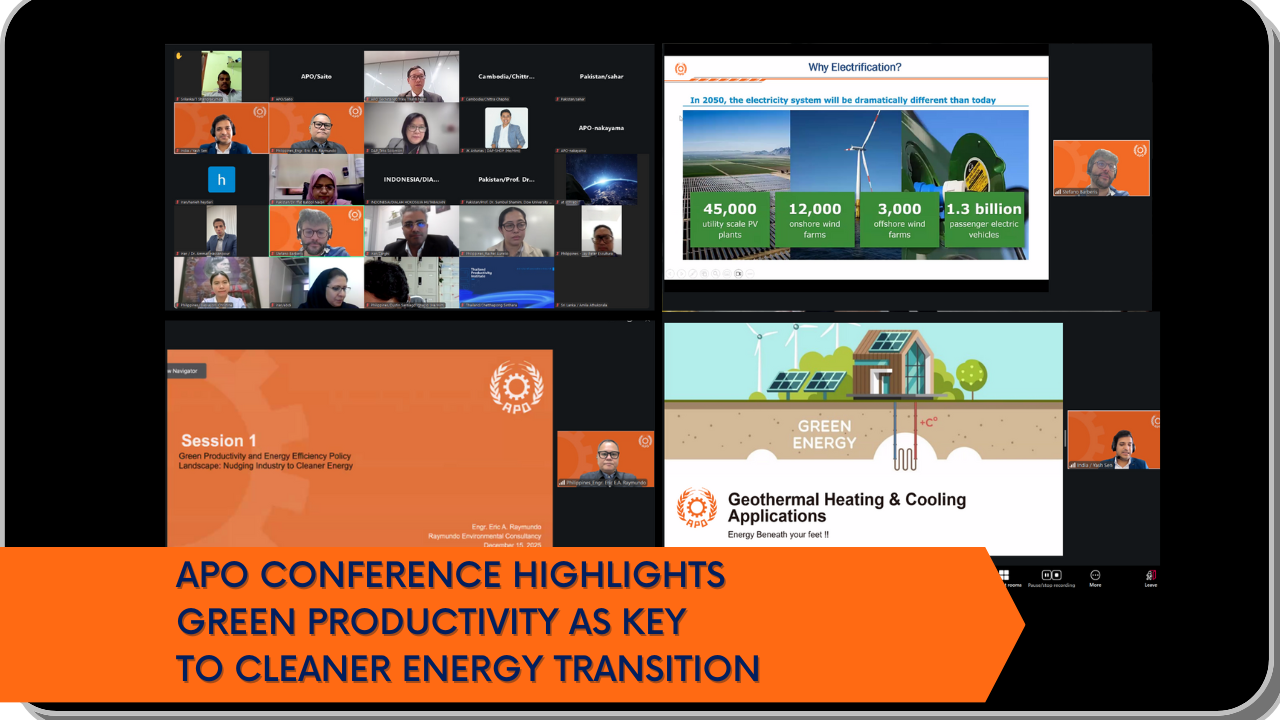
On 15 December 2025, the APO and the Development Academy of the Philippines hosted the Conference on Role of Green Productivity in Transition to Cleaner Energy online to show how GP can support clean energy strategies. The event strengthened the capacity of 75 participants from 11 APO member economies. Three resource persons from India, Italy, and the Philippines provided knowledge of energy efficiency policies, scalable clean energy solutions, financing mechanisms, and sector-specific decarbonization strategies. Participants explored advanced technologies, including electrification, green hydrogen for hard-to-abate sectors, and geothermal heating and cooling systems. The conference also fostered regional collaboration through integrated approaches combining policy, technology, and productivity for low-carbon development.
Participants showed strong interest in practical, scalable solutions for cleaner energy transitions. Discussions emphasized integrating policy instruments with technological innovation and highlighted the need for contextual approaches. Future efforts will focus on sector-specific GP 2.0 applications, interconnected training programs, and international sharing of case studies and management and financing models. These initiatives aim to ensure continuity, coherence, and stronger impact aligned with the APO’s vision for sustainable, low-carbon growth.