Select Page

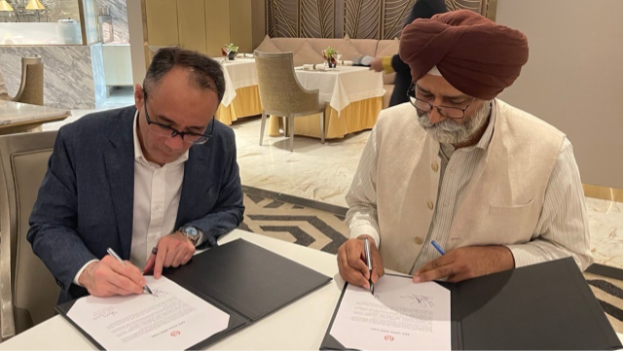
APO Secretary-General Dr. Indra Pradana Singawinata (L) and APO Director for India Amardeep Singh Bhatia (R) sign the Strategic Partnership Program (SPP) Primer for India in New Delhi, 22 May 2026.
22 May 2026 marked a significant milestone with the formal signing of the Strategic Partnership Program (SPP) Primer for India by APO Director for India Amardeep Singh Bhatia and APO Secretary-General Dr. Indra Pradana Singawinata. The signing ceremony was held after the successful conclusion of the 68th session of APO Governing Body Meeting (GBM) hosted by India, 20–22 May in New Delhi.
The SPP Primer outlines a comprehensive framework to support India’s strategic priorities, including digital transformation, sustainability, indigenous manufacturing, agricultural innovation, and public-sector productivity. Central to this framework is the Bharat Production System (BPS), which serves as a key mechanism for driving productivity improvements among MSMEs across sectors. Through its four pillars of stakeholder collaboration, strategic planning support, capacity empowerment, and knowledge creation, the SPP Primer for India aims to strengthen the country’s ability to design and implement effective productivity-enhancing policies and interventions.
This development reaffirms the shared commitment to advancing productivity, innovation, and sustainable economic growth among APO members. India, currently among the world’s largest economies, continues to pursue its vision of becoming a developed nation by 2047, with productivity enhancement at the core of this ambition.
Under APO Vision 2030, the organization will act as a catalyst by providing technical expertise, financial support, and capacity-building initiatives to help India achieve its long-term goals. This partnership also emphasizes knowledge sharing and collaboration with other APO member economies, fostering inclusive growth and environmental responsibility. The signing of the SPP Primer sets a strong foundation for sustained engagement, positioning India as a leader in productivity-driven development and paving the way toward a prosperous, developed future